There is a particular pleasure in discovering an artist before the market catches up to their talent — buying a piece because it moves you, because you want to live with it every day, and then watching the work get the recognition it always deserved. These are the artists I am personally watching right now. A few are already in major museum collections; others are just beginning to be noticed. What they share is work that changes a room, and that is the only test I apply.
Jason Middlebrook
Middlebrook does something that should not work as well as it does: he paints directly onto raw wood — rough-hewn planks, cross-sections of felled trees — covering the surface with intricate geometric and organic patterns that seem to grow from the grain itself. The result feels completely original: part painting, part sculpture, part natural artifact. His work is in the collections of MoMA, the Whitney, and the Museum of Fine Arts Boston. He lives and works in Hudson, New York — which has become the place where serious artists go when they want space to think. The pieces lean against the wall like something you found and could not leave behind. They are, without qualification, beautiful.


Sarah Martin-Nuss
Martin-Nuss makes landscape abstractions that feel like memory more than documentation — layered surfaces built up slowly until the painting holds a quality of light you recognize but cannot quite name. She completed her MFA at Pratt in 2024, which means she is genuinely at the very beginning. The work has a rhythmic quality, a sense of accumulation, that sets it apart from most abstract painting being made right now. These are paintings you would look at differently every morning.


Frances Palmer
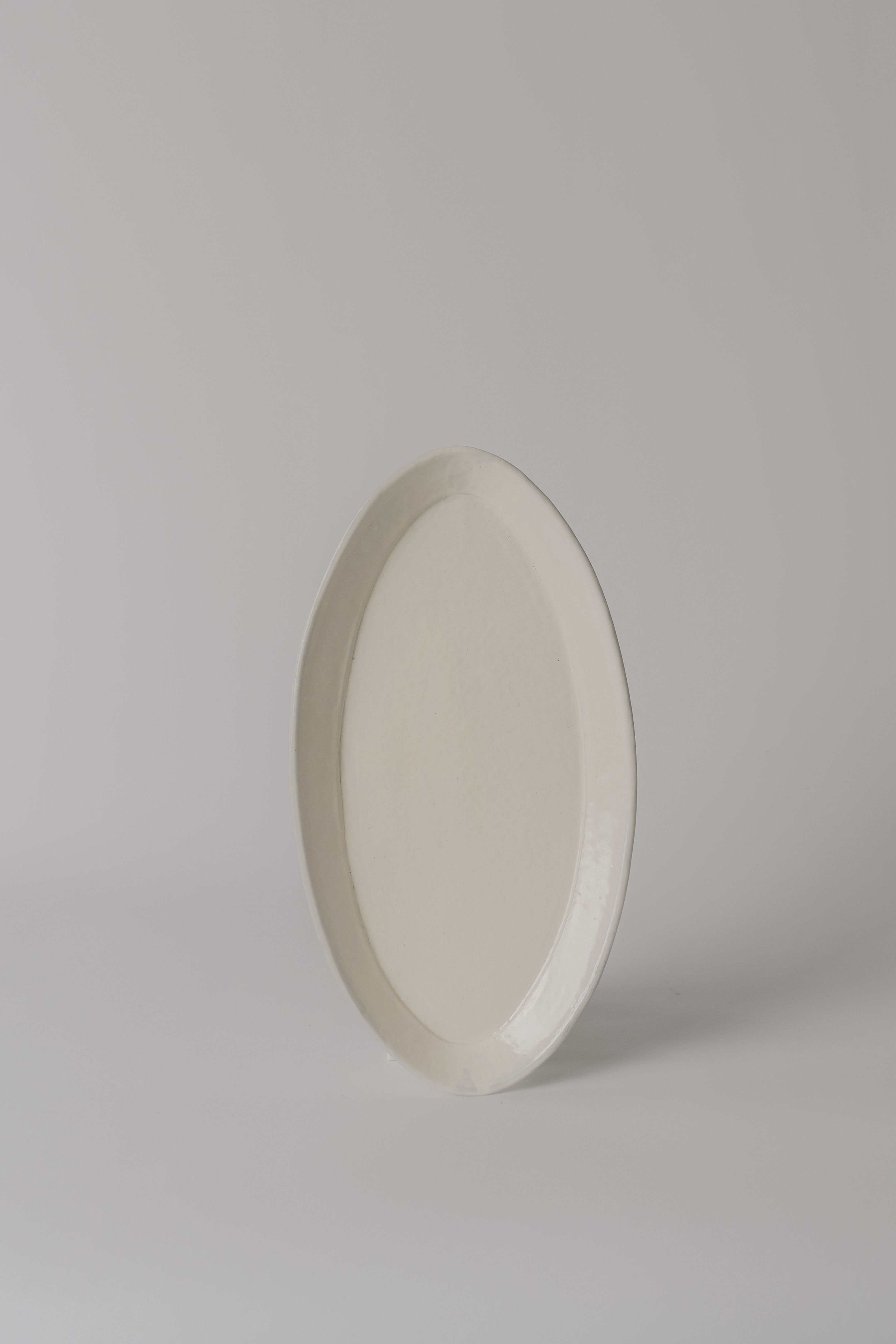
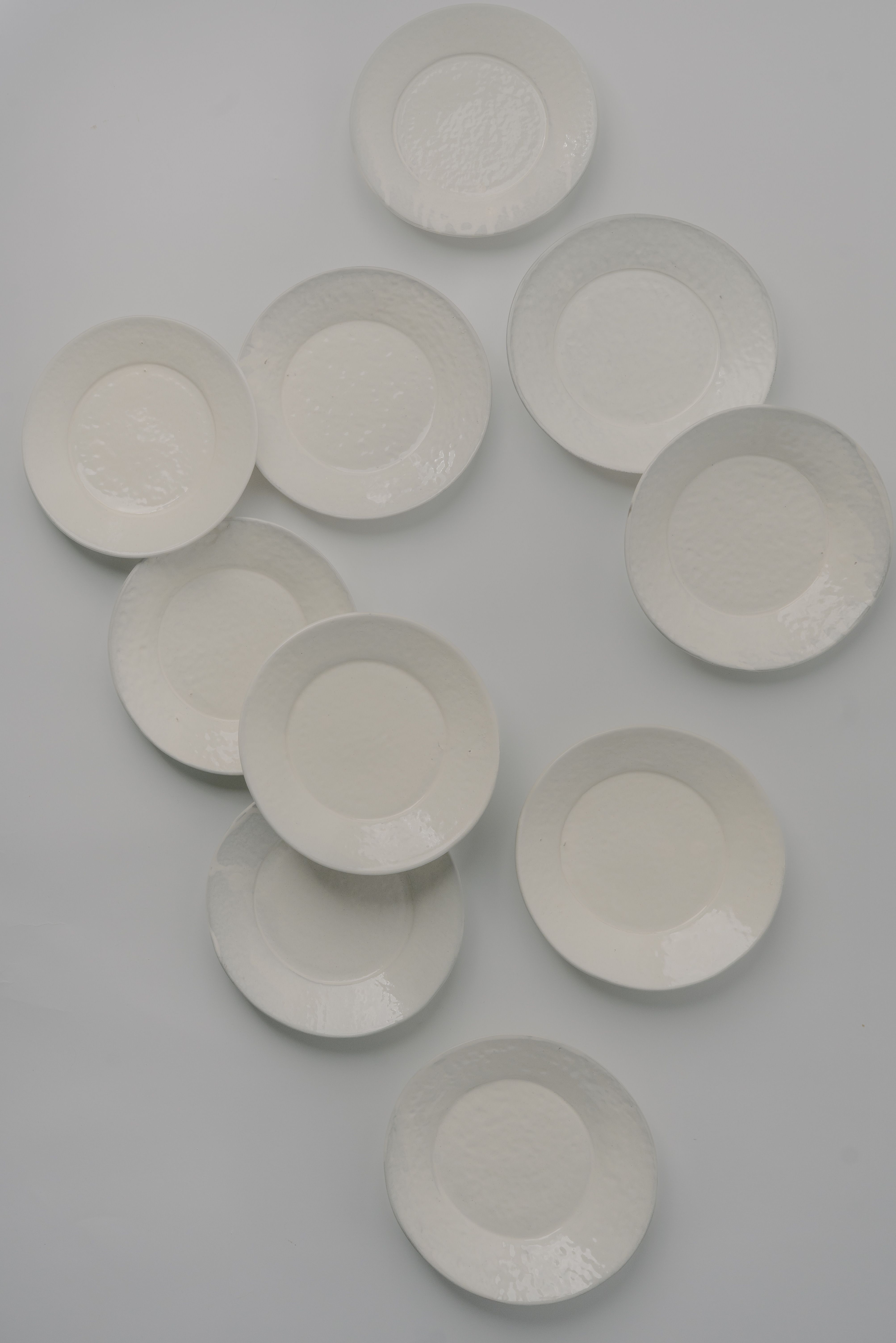
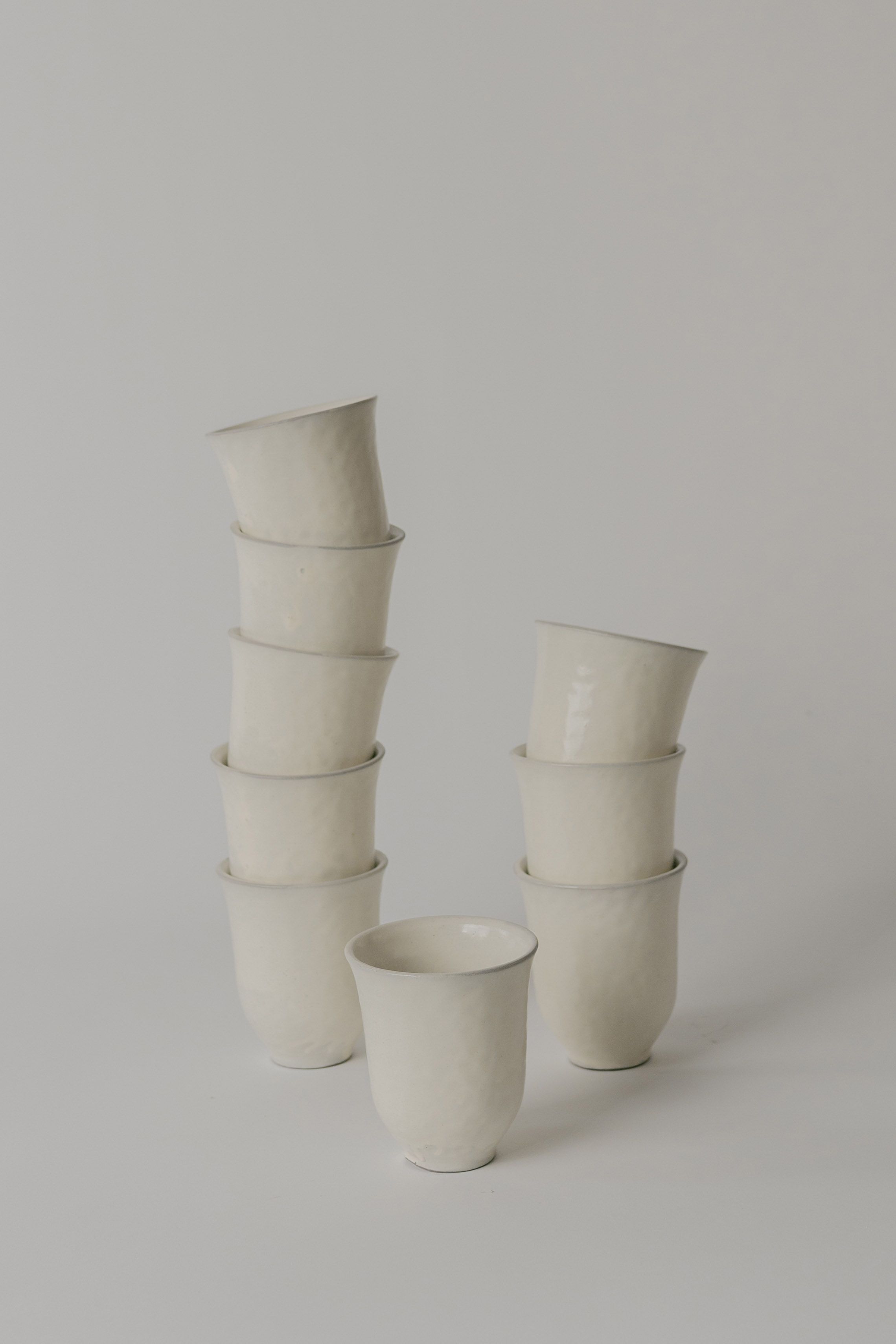
If you have been looking for a ceramicist whose work belongs genuinely in a beautiful room — not as a statement piece but as something that quietly elevates everything around it — Frances Palmer is the answer. Working from her studio in Weston, Connecticut, she makes glazed porcelain pieces with ruffled edges, fluted forms, and botanical details that feel simultaneously historical and entirely her own. Her work has been shown at the Neue Galerie and Wave Hill and sold at Barneys. Interior designers collect her because she does what great objects are supposed to do: she makes a room feel more considered without trying. Her pieces are still accessible. That will not always be true.


Jadé Fadojutimi
Fadojutimi is a British abstract painter represented by Gagosian, and her work is unlike anything else being made right now. The paintings are dense, gestural explosions of color and mark-making — layer upon layer, line upon line — and the more time you spend with them, the more you find. There is always another passage you missed, another color relationship you did not see on the first pass. Her philosophy is inseparable from the work: she paints from a place of pure joy and self-exploration, and that energy is completely present on the canvas. Nothing dark, nothing heavy — these are paintings that feel like being fully alive. She is young, she is at Gagosian, and her trajectory is straight up.


Janaina Tschäpe
Tschäpe is Brazilian-American and splits her time between New York and Brazil, and you can feel both in the work — a sensibility that is simultaneously precise and fluid, rooted in the organic world. Her paintings are soft and waterlike, full of movement, with a dreamlike color range that stops just short of the surreal. They are the kind of work that makes a quiet room feel inhabited. She has extensive exhibition history across Europe and the Americas, but her prices have not yet reflected the full scope of what she is doing. That gap will not last.


Diana Al-Hadid
Al-Hadid is a Syrian-American sculptor who builds hanging and wall-mounted works from polymer gypsum, steel, fiberglass, and wood — layered, poured, draped, and suspended until the material looks like it is in the middle of becoming something else. The forms are architectural and flowing simultaneously, suggesting ruins or waterfalls or half-dissolved structures. What draws me to her work is the material intelligence: there is no other sculptor quite using these combinations in this way. She has shown at the Hammer Museum, the Dallas Museum of Art, and extensively in Europe. The work is complex enough to keep pulling you back, and the scale — many pieces hang from the ceiling or cascade down walls — makes a room feel genuinely transformed.


Tara Donovan
Donovan takes the most ordinary materials imaginable — plastic cups, mylar sheets, index cards, toothpicks, buttons — and assembles them into large-scale sculptures and installations that look like natural phenomena. Clouds. Fog banks. Coral reefs. The surface of a pond. Standing in front of one of her works, you know exactly what the material is, and you have no idea how it becomes what it becomes. The complexity is absolute — there is always another layer, another relationship, another passage of light. Her work is in the collections of MoMA, the Whitney, and the Metropolitan Museum. It is completely positive, completely beautiful, and unlike anything being made by anyone else.


El Anatsui
El Anatsui is Ghanaian and has been making his signature hanging tapestries for decades — enormous flexible works woven from thousands of flattened bottle caps and strips of aluminum, held together with copper wire. They hang like fabric but shimmer like metal, pooling on the floor in folds of gold, silver, and bronze. The complexity is genuinely extraordinary: each piece contains tens of thousands of individual elements, and the color relationships across the surface shift with every change in light. His work is in the Tate, the Metropolitan Museum, and major collections worldwide. He is not unknown — but his work belongs on any list of the most beautiful things being made anywhere, and his prices remain accessible relative to what the work is. It is impossible to stand in front of an Anatsui and not feel elevated.
Art collecting at this level — early, based on genuine response to the work — is one of the most personally rewarding things you can do for your home. If you want help thinking through how art fits into a space, or selecting works that will grow with a room over time, that is exactly the kind of conversation I love to have.


Flora Yukhnovich
British painter Flora Yukhnovich has quickly become one of the most talked-about artists of her generation, thanks to her lush, layered paintings that reimagine Rococo aesthetics through the lens of contemporary abstraction. Represented by Victoria Miro gallery, her large-scale canvases pulse with soft, cascading color — pinks, ivories, and powder blues that dissolve at the edges into gestural strokes. Her work feels both opulent and emotionally resonant, referencing Tiepolo and Boucher while remaining entirely of the present moment. With recent exhibitions in London, New York, and across Europe, Yukhnovich is already commanding serious attention at auction — and those who acquire her work early stand to benefit considerably as her market continues to climb.


Hurvin Anderson
British-Jamaican painter Hurvin Anderson occupies a singular position in contemporary painting, celebrated for his coolly luminous images of swimming pools that carry layers of cultural memory, longing, and racial identity. His canvases — often featuring the aqueous blues and tile patterns of leisure spaces — are at once serene and deeply freighted with meaning. Anderson has exhibited at the Tate and is represented by Thomas Dane Gallery; his work is in the collections of the Tate, the Museum of Contemporary Art Chicago, and numerous private collections worldwide. The combination of photorealistic precision and painterly restraint places him in a rare category of painters whose work rewards close, extended looking.


Ursula von Rydingsvard
Sculptor Ursula von Rydingsvard creates monumental works from hand-hewn cedar that carry an almost primal presence. Born in a German refugee camp in 1942 to Ukrainian parents, von Rydingsvard has spent decades developing an entirely distinctive vocabulary of form — carving, splitting, and laminating vast cedar beams into towering, organic structures that suggest ritual objects, landscapes, and the body simultaneously. Her surfaces are rubbed with graphite until they achieve a deep, darkened patina that adds to their ancient quality. Von Rydingsvard’s sculpture has been exhibited at the Venice Biennale, MoMA, and the Smithsonian; her work stands at the intersection of feminist art history, abstract sculpture, and deeply personal storytelling.


Simone Bodmer-Turner
New York ceramicist Simone Bodmer-Turner works at the threshold between vessel and sculpture, creating organic, biomorphic forms in stoneware that seem to breathe. Her pieces — bulbous, gently asymmetrical, and finished in earthy glazes of ochre, slate, and cream — evoke seeds, gourds, and the quiet forms of nature without ever becoming literal. Each work is hand-built and singular, making her studio practice one of the most intentional and collectible in contemporary ceramics. As the art world’s appetite for thoughtful studio ceramics has grown dramatically, Bodmer-Turner’s work has moved quickly through galleries and is increasingly difficult to acquire directly. Her pieces bring a sculptural seriousness and organic warmth that feels exactly right in a designed interior.
Art to Collect

Violet Cascade
From $700

Coral Flow
From $700

Liquid Drift
$700

SOMETHING FOR EVERYONE
THE PIECES RACHEL RETURNS TO, AGAIN AND AGAIN
Before you go
Not sure what your style is? Take the two-minute Style Quiz and I’ll send you your look.